
Five Years Is a Long Time to Wait for a "Yes"
I asked for Hormone Replacement Therapy, HRT. They said no.
That was 2020, months after emergency surgery, a hysterectomy, oophorectomy, and omentectomy. Chronic inflammation. Breast pain. Intense dizziness. Joint pain.
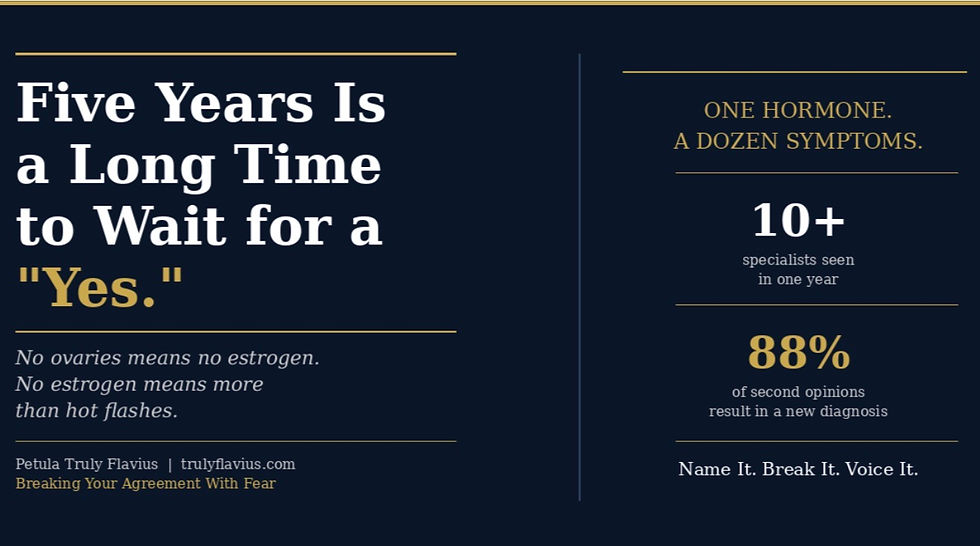
In the first year alone, I saw over 10 specialists.
I started HRT recently.
What the First Year Looked Like
Ten-plus specialists in twelve months. Different offices, different waiting rooms, the same basic story told over and over.
I never heard the words "there's nothing wrong with you" or "you're being dramatic" out loud. Nobody said that. But I felt it, in the pace of the appointment, in how quickly we moved on, in something I started reading in people's eyes that I couldn't always prove was there.
One neurologist wanted to prescribe antidepressants. I said no. Not because I thought depression wasn't real or worth treating, but because what I was feeling didn't match that. It felt like my body was malfunctioning in a physical way, and masking it with something else felt like it would bury the actual cause instead of finding it.
I want to be honest: some of what I felt from others may have been me, transposing my own fear and self-doubt onto rooms where nothing was actually being said. I can't know for certain what was in anyone else's head. What I do know is how it felt, and how that feeling built up until I stopped making the eleventh appointment.
No Ovaries Means No Estrogen. No Estrogen Means More Than Hot Flashes.
Here's what I didn't fully understand in 2020, and what almost none of those ten specialists explained: estrogen isn't just a "reproductive hormone." It touches nearly every system in the body.
During menopause, estrogen deficiency alters mast-cell behavior, increasing histamine release while reducing the body's ability to break histamine down. A 2026 review described this as a collision between declining hormones and an immune system whose mast cells are exquisitely sensitive to those hormones, changes that can unmask new allergic and inflammatory symptoms or worsen existing ones. That's the histamine intolerance I eventually self-diagnosed.
Estrogen also plays a fundamental role in bone homeostasis, and estrogen deficiency is considered the greatest risk factor for postmenopausal osteoporosis. That's the DEXA result from 2023.
And estrogen loss, whether through natural menopause or surgical removal of the ovaries, has been linked to changes in inflammation and cognition. That's the brain pressure, the dizziness, the joint pain.
One missing hormone. A dozen seemingly unrelated symptoms, each one sent to a different specialist, none of whom were looking at the hormone connecting all of them.
Giving Up on Doctors, and Starting My Own Research
After that first year, I stopped scheduling new specialist visits. Not out of anger. Out of exhaustion.
I started researching instead. Symptom by symptom, late at night, piecing together a picture nobody had handed me. I self-diagnosed a histamine intolerance. Then a sugar intolerance. And eventually, the thread that connected them: estrogen deficiency, the thing I'd asked about in 2020 and been told no on.
I didn't have a medical degree's worth of certainty. I had a pattern, built from my own symptoms and my own reading, that nobody else had ever laid out for me.
What the Data Says About Second Opinions
Roughly 68% of patients who seek a second opinion do so to get a different diagnosis or prognosis, and 65% report receiving more certainty about their diagnosis or treatment options as a result.
Here's the number that stopped me: in Mayo Clinic research, 88% of patients who sought a second opinion left with a new diagnosis. The original diagnosis was confirmed as correct in only 12% of cases.
Ten specialists, and not one of them connected the dots I eventually connected myself, alone, with a search bar and a stack of lab results.
Naming It
For years, naming it would have meant admitting: I gave up on getting help, and I started doing this alone.
The fear wasn't really of doctors. It was the fear of walking into appointment number eleven and feeling that same impatience again, the fear of being "that patient," the one with too many symptoms and no clear diagnosis.
That fear kept me out of offices for years. I prayed about my body more than I spoke about it.
Breaking It
This year, I went back. This time to my GYN, with everything I'd pieced together myself and the updated guidance my PCP had pointed me toward.
This GYN wasn't familiar with the current HRT recommendations. Her notes referenced older guidance. I had to advocate, clearly and respectfully, for what my PCP had specifically sent me to her to get.
She prescribed it, at the lowest possible dose.
I don't blame her for that. When a provider doesn't have the most current information in front of them, starting low and cautious is exactly what protecting a patient looks like. That's not negligence. That's care, operating with the information available in that moment.
Voicing It
Here's what I'm voicing: it took ten specialists, a year of feeling unseen, and years of self-research before I walked into a room with enough information to advocate for myself, and even then, the provider in front of me didn't have the updated guidelines I did.
I've taught women for years to use their voice. It took me five years to use mine in an exam room, about my own body, and even then, I had to bring the information with me.
I'm voicing it because if it took me this long, with everything I know, someone else is in year three of their own version of this right now.
What This Looks Like Going Forward
Guidelines change faster than any one provider can track across every specialty. That's not a flaw, it's the reality of modern medicine.
Bringing current guidelines to an appointment isn't distrust. Most specialists handle these conversations regularly and are careful not to undermine other providers, this is simply how informed care works now.
It looks like:
Bringing what you've found, even if it's from your own research, framed as "I read this, can we discuss it?"
Asking, "Is there updated guidance on this that might change the approach?"
Receiving a cautious first step, like a low dose, as a starting point, not a final answer.
Make AI Your Research Partner
This is part of what changed things for me. I started using AI tools to help organize my symptoms, search for current guidelines, and understand my own lab results well enough to ask better questions.
The key is how you ask. Don't ask "what's wrong with me", that's not what these tools are for, and you won't get a useful answer. Instead, ask things like: "What are the current guidelines for [condition] as of this year?" or "Can you help me understand what this lab result means and what questions I should ask my doctor?"
Used this way, AI doesn't replace your provider. It helps you walk into the appointment already informed, which is exactly what makes these conversations work better for everyone.
Practical Takeaway
If you've stopped going to doctors because it felt like nobody was listening, you're not wrong for needing a break. But the information you gather on your own can become the bridge back, not instead of medical care, but as part of the conversation.
Write down your pattern. Bring it with you. You don't have to have all the answers to be taken seriously, you just have to show up with what you've noticed.
This Conversation Is Bigger Than One Appointment
A year of feeling dismissed, followed by years of silence, followed by self-diagnosis through late-night research. That's not a rare story. That's the cost of women not being heard the first time, and not knowing how to come back the second.
I bring this conversation into women's events and organizations through Breaking Your Agreement With Fear and Burnout Is a Signal Not a Shame.
Book a keynote or workshop: trulyflavius.com/booktrulyflavius
#WomensHealth #HRT #Menopause #EstrogenDeficiency #SecondOpinion #BreakingYourAgreementWithFear #SisYoureNotAlone #PatientAdvocacy #HighAchievingWomen #SurgicalMenopause



Comments