
I Was Not Depressed. I Was Disappearing

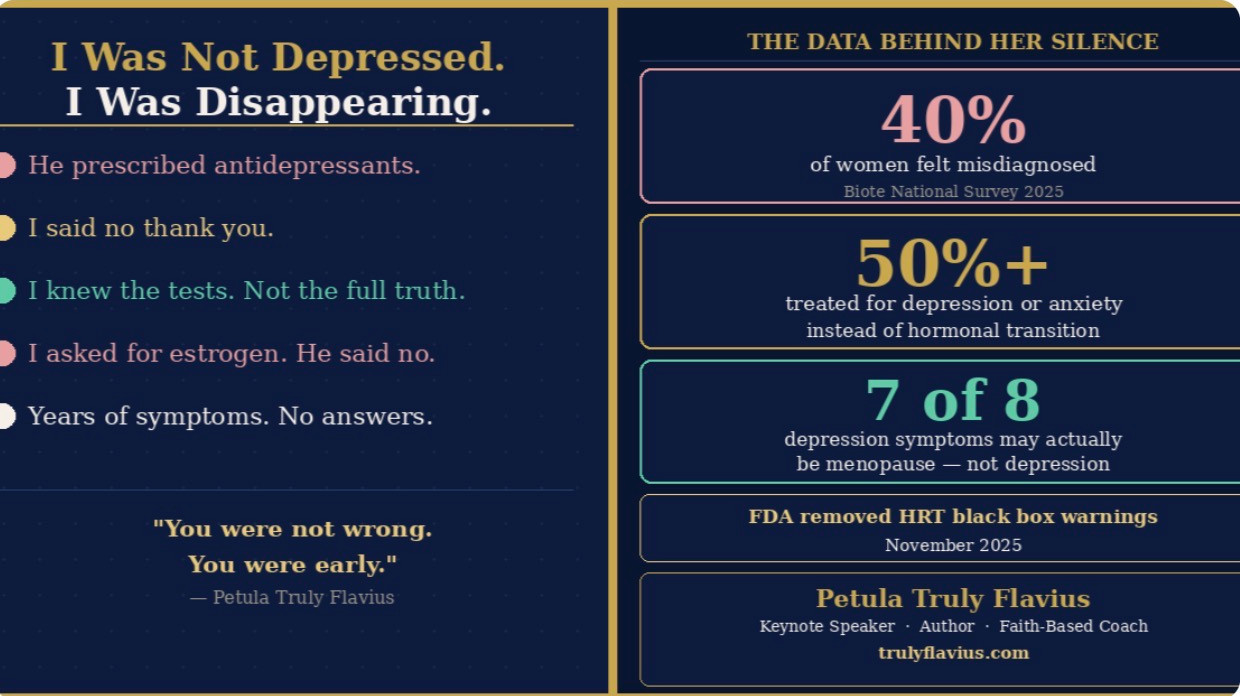
He prescribed me antidepressants. I said no thank you.
I have over 20 years in healthcare. I know what depression looks like. I know what it feels like. And I know the difference between a woman who is mentally unwell and a woman whose body is in a crisis that nobody has the language to name yet.
I was the second woman. And it took everything I had — my faith, my stubbornness, and years of searching — to finally understand what was happening to me.
This is that story. And I believe it belongs to more women than just me.
My body whispered a year before it screamed.
The first visit to the emergency department came before I had words for what was wrong. Something was off. I felt it. The tests came back. The results were reviewed. Everything was normal.
I went home.
A year later, my body stopped whispering.
What came next was not gradual. It was not subtle. It was a full system revolt that I did not have a single name for — brain pressure so intense I could feel it behind my eyes, vision that blurred without warning, hearing that started slipping away, and the terrifying sensation of nearly losing consciousness in loud environments.
And then came the one nobody talks about.
Creepy crawlies. All over my body. The feeling of something moving under my skin when nothing was there.
I am a healthcare professional. I knew that symptom would raise eyebrows. I knew how it sounded. And I knew — with every bit of clinical knowledge I had spent over two decades building — that something in my body was very, very wrong.
She Did Everything Right
Let me be clear about what I did not do.
I did not ignore it. I did not minimize it. I did not sit at home and hope it would pass.
I went back to the emergency department. Tests were run. Procedures were done.
Allergy panels came back negative. Every result pointed to the same answer:
Normal.
And then the specialist carousel began.
One after another. Each one with their area of expertise. Each one with their tools and their protocols. Each one looking at a piece of the puzzle without ever seeing the whole picture.
Until one of them looked at me — a woman with brain pressure, vision loss, hearing disturbances, near fainting episodes, and skin that felt like it was crawling — and prescribed antidepressants.
I said no thank you.
Not because I do not respect the process. Not because I dismiss what medication does for women who truly need it. But because I am a healthcare professional with over 20 years of experience and I knew — with every bit of clinical knowledge I had spent two decades building — that depression was not what was happening inside my body.
Not one symptom of depression. Not one.
His response was that the medication might alleviate my neurological symptoms.
I heard him. I respected his training. And I still said no thank you.
Because a woman who knows her own body — and who has spent her career understanding other people's — knew that the answer to what she was experiencing had not walked through that door yet.
The Phases Nobody Prepares You For
What comes next in a story like this is not linear. It is not clean. It is not the kind of journey that fits neatly into a diagnosis or a treatment plan.
It is a woman trying to understand her own body when the systems around her have run out of answers.
I went through phases. Some of them medical. Some of them deeply personal.
I explored gluten intolerance. I researched histamine intolerance. I read everything I could find about why a woman's body might react so violently to food that used to be safe. I changed what I ate. I tracked my symptoms. I became my own investigator because nobody else was connecting the dots.
And then there were the phases that go deeper than medicine.
I am a woman of faith. And when science runs out of answers, faith does not. I leaned into prayer. I leaned into God. I asked questions I had never asked before — not because I doubted, but because I needed to understand why this was my path.
And I will say something that will resonate with every Caribbean woman reading this:
In moments of desperation, your mind goes to places your culture understands even when medicine does not.
Could this be spiritual warfare? Could something be happening in the unseen that the visible world could not explain?
I am from the Caribbean. I understand what it means to wonder if something beyond the physical is at work. And I will not apologize for being a whole woman — body, mind, and spirit — who needed answers from every dimension of her existence.
What I know now is that what was happening to me had a name. It had research behind it. It had a biological explanation that connected every single symptom I had been carrying alone.
But I had to find it myself.
What Was Actually Happening
In 2020 I had a total hysterectomy and bilateral oophorectomy. My ovaries were removed. And with them — immediately, not gradually — my body lost its primary source of estrogen.
Estrogen is not just a reproductive hormone. It is a neurological regulator. A cardiovascular protector. An anti-inflammatory agent. And as I shared in my first article — it is the body's natural antihistamine.
When estrogen drops suddenly through surgical menopause, the body does not have years to adjust the way it does in natural menopause. It goes from full hormonal function to near zero — overnight.
And the symptoms that follow can look like almost anything except what they actually are.
Nearly 40% of women seeking care for perimenopause and menopause symptoms report feeling misdiagnosed. More than 50% were treated for anxiety, depression, panic attacks, or mood disorders — with 33% receiving diagnoses and treatment for anxiety, 27% for depression, and 13% for panic attacks. Among women prescribed medication for mental health conditions, more than one third believed they were not appropriately diagnosed. (Source: Biote National Survey, November 2025 — Contemporary OB/GYN)
Read that again.
More than half of women going to their doctors with hormonal symptoms are walking out with mental health diagnoses instead.
Seven of the eight conditions on the Patient Health Questionnaire depression scale may actually be caused by perimenopause or menopause rather than clinical depression — including sleep disruptions, changes in appetite, fatigue, trouble concentrating, and mood disturbances. (Source: Patient Care Online, November 2025)
The tools being used to diagnose depression in women were not built with menopause in mind. And that gap is costing women their health, their clarity, and their sense of self.
And the creepy crawlies? The sensation I was almost embarrassed to describe?
Formication — the sensation of skin crawling or tingling without a physical cause — is a lesser known but distressing symptom that can emerge during perimenopause and menopause. Hormonal fluctuations, particularly declining estrogen, impact skin health and nerve sensitivity, making midlife women more susceptible to these sensations. (Source: MyAlloy Women's Health, April 2025)
It had a name. It was documented. It was real.
And a global systematic review and meta-analysis of 321 studies comprising 482,067 middle-aged women confirmed formication as a recognized menopausal symptom — one that most women have never heard of and most clinicians do not think to mention. (Source: BMC Public Health, July 2024)
I was not imagining it. I was not anxious. I was not depressed.
My body was in surgical menopause. And nobody had connected that to what I was experiencing.
She Asked for the Answer. She Was Told No.
Here is the part of this story that stops me every time I tell it.
Six months after my surgery — before the full onslaught of symptoms had arrived, before the specialist carousel, before the emergency department visit, before the antidepressant prescription — I went back to my gynecologist.
I had spent years working in a laboratory setting. I knew the tests. I could read the results. I understood prescriptions. So when my ovaries were removed I knew enough to know that estrogen was gone.
What I did not know — what nobody fully told me — was the depth of what estrogen loss could actually do to a woman's body. The neurological impact. The histamine connection. The brain. The ears. The eyes. The skin. The food reactions. The complete systemic unraveling that was coming.
I knew the science. I did not know my own story yet.
And I knew enough to ask for what I needed back.
I asked for estrogen therapy.
He said no.
His reason was one that many women of that era heard from their physicians — too many women on estrogen were being diagnosed with cancer. The risk was too high. The answer was no.
I accepted it. Because he was my doctor. Because I trusted the system I had devoted my career to. Because I did not yet know what the years ahead would cost me.
What followed — the brain pressure, the vision loss, the hearing disturbances, the near fainting, the formication, the food reactions, the specialist visits, the normal results, the antidepressant prescription I refused — all of it came after a door was closed that should have been opened.
Now it is 2025.
In November 2025, the FDA removed certain black box warnings from menopausal hormone replacement therapy products — warnings that had been discouraging appropriate treatment for women who could benefit from symptom relief and improved quality of life. Updated guidance now emphasizes starting hormone therapy before age 60 or within 10 years of menopause and calls for individualized decisions rather than blanket fear. (Source: FDA.gov, November 2025)
The Menopause Society now recommends that women who experience early menopause due to hysterectomy or other reasons should receive hormone therapy until at least the average age of natural menopause — which is 52 — unless there are specific contraindications. (Source: The Menopause Society, updated guidelines 2025)
Hormone therapy is now one of the most talked about topics in women's medicine. It is being prescribed, celebrated, and in some spaces, marketed widely as a breakthrough for midlife women's health.
It is not a breakthrough. It is a correction.
The treatment existed when I needed it. The conversation just had not caught up yet.
And I want every woman reading this to sit with that for a moment — not with bitterness, not with blame, but with clarity. Because understanding what happened to us is not about assigning fault. It is about making sure it does not keep happening to the women who come after us.
If you were denied hormone therapy in that era and spent years suffering through symptoms that had an available treatment — your experience was real. Your suffering was real. And the medical conversation has now confirmed what your body was trying to tell you all along.
You were not wrong. You were early.
What Faith Did That Medicine Could Not
I want to be clear — I believe in medicine. I have devoted over two decades of my professional life to healthcare. I respect the clinicians who tried to help me. I understand the gaps in training that exist around surgical menopause. This is not a story about blame.
This is a story about a woman whose faith carried her through the space between what medicine could offer and what her body needed.
If it were not for my faith I do not know where I would be today. The honest answer is somewhere much darker. My faith made me aware that God could see me through anything — and that what I was going through was not the end of my story. It was the test that would become my testimony.
It kept me from accepting a diagnosis that was not mine. It kept me searching when every result said normal. It kept me standing in rooms where I felt like I was disappearing and reminded me that I was still here. Still whole. Still becoming.
Faith did not replace the answers I needed. But it held me together long enough to find them.
What This Means for Every Woman Reading This
If you are a woman who has been handed a mental health diagnosis that never quite fit — ask about your hormones. Ask specifically about surgical menopause, premature ovarian insufficiency, or perimenopause. Ask about formication, histamine intolerance, sugar intolerance, and estrogen's role in neurological regulation. Ask why fruit is giving you brain fog. Ask why food that was safe before your surgery is now sending your body into chaos. Ask why your skin crawls, your ears ring, and your vision blurs — and keep asking until someone connects the dots.
You are allowed to ask. You are allowed to advocate. You are allowed to say — like I did — this is not the answer for me.
Only 15% of women felt adequately informed at symptom onset, and only 26% learned about perimenopause from their primary care provider. Many turned to Google or family members for information. (Source: Biote National Survey, November 2025)
That number is not a reflection of women failing to seek help. It is a reflection of a healthcare conversation that has not yet caught up to the full complexity of what women's bodies experience after hormonal transition.
You are not failing your body. The conversation has been failing you.
And for the organizations where women like us show up every single day — still performing, still leading, still delivering — while carrying symptoms that nobody in the building knows how to name:
The woman in your meeting who seems distracted is not disengaged. The woman who used to run the room and now seems hesitant is not losing her edge. The woman who asked for a quieter workspace is not being difficult.
She may be disappearing. And she needs more than a performance review. She needs a conversation her workplace does not yet know how to start.
Practical Takeaways
For the woman: Ask your doctor specifically about all types of menopause — natural, surgical, premature, chemical, and perimenopause — and how each one affects your body differently. Ask about formication, histamine intolerance, sugar intolerance, and the neurological effects of estrogen loss. Ask about DAO enzyme deficiency. Ask why foods that were once safe are now triggering reactions. Ask about hormone therapy options and what the updated 2025 FDA guidance means for your specific situation. Seek a functional medicine physician or integrative gynecologist if your current provider does not have answers. Keep a symptom journal. Your patterns are data. Your body is not lying to you.
For the organization: The menopause conversation does not belong only in HR. It belongs in leadership development, wellness programming, and manager training. Natural menopause, surgical menopause, premature ovarian insufficiency, perimenopause, and chemically induced menopause are all represented in your workforce right now. Add all of them to the conversation. Train your managers to recognize that a performance shift in a midlife woman may have a physiological root that has nothing to do with her commitment or capability. Review your benefits structure for gaps in hormonal health coverage. The woman who looks strong in every meeting may be the one who needs the most support.
For everyone: Share this article with one woman who has been told her results are normal while her body tells her otherwise. She needs to know she is not alone — and she is not disappearing. She is waiting for the right conversation to find her.
Petula Truly Flavius is a keynote speaker, author, and faith-based coach with over 20 years in healthcare who helps midlife women who look strong on the outside but secretly battle fear — name it, break the agreement with it, and use their voice to rise anyway. She is the author of Weeping Her Way to Wholeness and Bullied to Bold, and the founder of Sis You're Not Alone.
Book Truly to speak at your next women's conference, corporate event, leadership summit, or retreat: trulyflavius.com/booktrulyflavius
📩 Email: petulaflavius1@gmail.com
Connect on LinkedIn: linkedin.com/in/trulyflavius


Comments