
When Burnout Wears a Business Suit

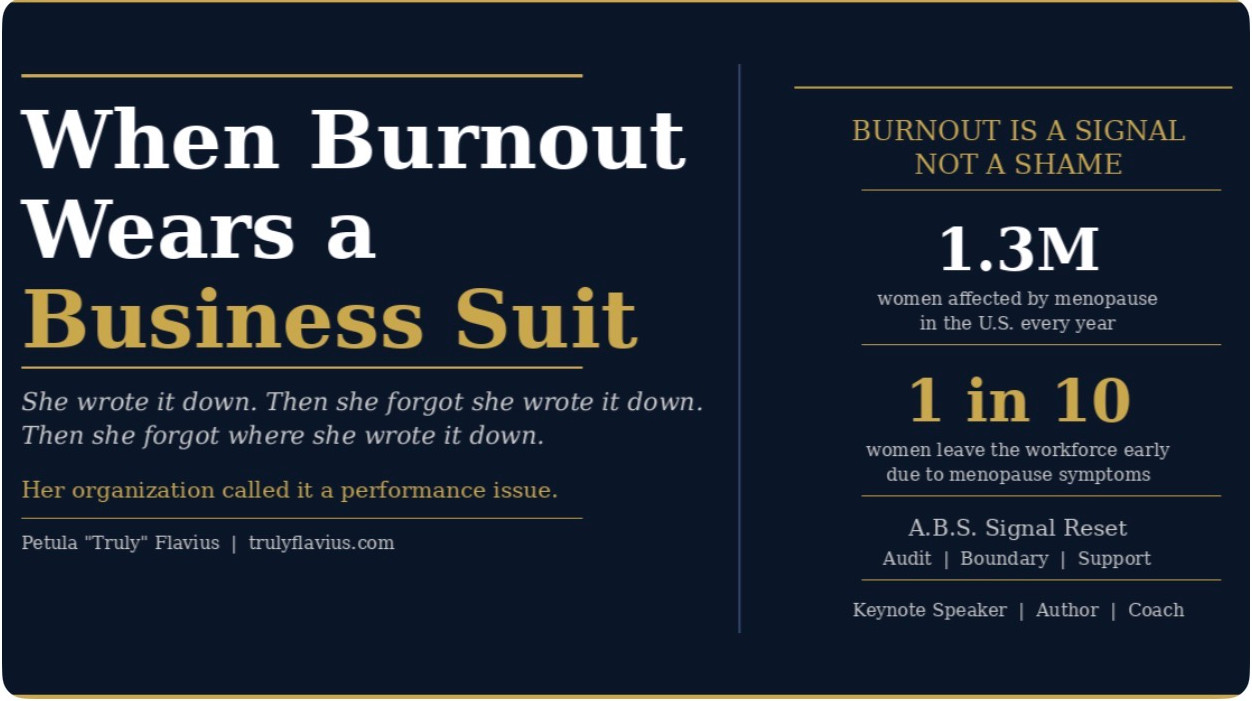
She wrote it down. Then she forgot she wrote it down. Then she forgot where she wrote it down.
Her organization called it a performance issue.
She had thirty years in her field. Three decades of showing up, delivering, leading, and producing. The kind of employee organizations build succession plans around. The kind of woman who trained the people who now sit above her. The kind of woman whose name gets mentioned in conversations about the next leadership opening.
And she was sitting across from me completely undone.
Not because she was weak. Not because she stopped caring. But because for two years she had been writing things down and forgetting she wrote them. Walking into rooms and standing there blank. She would open her mouth in a meeting and the word she needed would just be gone. Not delayed. Gone. She was snapping at people she loved. Lying awake at 3am with her heart racing and her mind louder than it had ever been. Her patience, which had always been one of her greatest professional strengths, had become the thing she was rationing like it was running out.
She thought she was losing her mind.
Her organization thought she was losing her edge.
And every single day she walked into that building looking like nothing was wrong. She performed fine so convincingly that nobody thought to look closer. She smiled in meetings. She delivered on time. She mentored junior staff. She sat in leadership conversations and contributed just enough to stay invisible in the right ways.
She hid it from her colleagues. She hid it from her family. She hid it from everyone who might have helped her.
But here is what nobody talks about: the hiding was its own full-time job. The energy it takes to perform okay when you are not okay is exhausting in a way that compounds daily. She was spending as much cognitive and emotional energy managing how she appeared as she was spending doing her actual work. She was running two jobs. Her organization was only paying for one.
Nobody, not her boss, not her director, not her coworkers, not HR, asked her a single question about her health.
The Most Expensive Employee in the Building
Here is what organizations consistently get wrong about burnout: they think they will see it coming.
They will not. Not in this woman.
High-performing women do not look burned out. They look like your most reliable people. They are still in every meeting. Still hitting every deadline. Still the first to volunteer when a project needs saving and the last to admit they are drowning.
They are also running on a system that is quietly breaking down in ways no performance review, no engagement survey, and no one-on-one will ever surface — because she has already decided that telling the truth is not safe.
Gallup's research on employee burnout estimates it costs organizations between 15% and 20% of total payroll annually through absenteeism, presenteeism, and turnover. But that number does not account for the woman who never fully disengages. She stays. She delivers. She just quietly stops raising her hand, stops generating ideas, stops mentoring with the generosity she once had, stops believing the organization actually sees her.
And then one Tuesday she submits a resignation letter and everyone is genuinely shocked.
Nobody saw it coming.
Except her. She saw it coming for two years. She just did not have the language, the safety, or the organizational support to say it out loud.
The question is not whether burnout is expensive. We already know it is. The question is whether your organization knows how to see it before it walks out the door wearing its resignation letter like a business suit.
The Variable Nobody Is Measuring
The woman I sat across from was not burned out from her workload alone.
Her body was in the middle of a significant hormonal transition — one that was directly affecting her cognition, her memory, her emotional regulation, her sleep quality, and her ability to manage stress. The symptoms she described, the word retrieval issues, the brain fog, the 3am wakefulness, the emotional volatility, the feeling that something was fundamentally wrong with her brain, are documented, researched, and well understood in clinical literature.
They are almost entirely absent from organizational conversations about performance and retention.
The Mayo Clinic estimates that menopause affects roughly 1.3 million women in the United States every year. These are not women at the end of their careers winding down toward retirement. They are often at the absolute peak of their professional lives. Managing teams. Driving revenue. Holding thirty years of institutional knowledge that took decades to build and cannot be replaced with a job posting.
A 2023 study published in the journal Menopause found that nearly one in ten women leave the workforce early due to menopause symptoms. Another study from the Fawcett Society found that over a million women in the UK alone had left jobs because of menopause. The data exists. The cost is documented. The conversation just has not made it into most organizations yet.
So these women do what high-achieving women always do. They adapt. They compensate. They push through. They write it down and forget they wrote it down. And they say nothing, because saying something feels like handing someone a reason to pass them over.
Your organization is calling it a performance issue.
It is a health issue your culture was never built to hold.
The Signal Hiding in Plain Sight
Burnout in high-achieving women is not a personal failure. It is an organizational data point.
When your most experienced women start going quiet in rooms where they used to lead, that is a signal. When the woman with thirty years of expertise starts second-guessing decisions she used to make without blinking, that is a signal. When she stops advocating for herself or her team, stops applying for the next opportunity, stops showing up with the energy she used to bring, that is not disengagement. That is a depleted human being doing her best inside a culture that was never built to see her fully.
The cost of not reading that signal is not just one resignation. It is the mentorship she was providing. The institutional knowledge she was carrying. The team culture she was holding together. The clients who trusted her specifically. The pipeline she was quietly building.
The organizations that learn to read that signal will keep their best people longer, build cultures that actually retain the talent they spent years developing, and stop losing experienced women to competitors who figured this out first.
The ones that do not will keep scheduling exit interviews and wondering what they missed.
The A.B.S. Signal Reset: What the Conversation Needs to Look Like
I developed the A.B.S. Signal Reset framework because I watched too many high-achieving women try to recover from burnout using the same energy that caused it. They were given self-care checklists and told to take a vacation. They came back from the vacation tired.
The problem was never the individual. The problem was the system the individual was operating inside of. And you cannot fix a systems problem with a personal solution.
A.B.S. stands for Audit, Boundary, and Support. All three steps are required. You cannot skip to Support without doing the Audit. You cannot hold a Boundary in a culture that was never built to honor one. And Support without the first two steps is just sympathy with better catering.
The Audit is where we stop assuming and start looking. What is actually depleting her? How much of it is workload? How much is invisible labor, the emotional management, the code-switching, the constant translation of herself for rooms that were not built with her in mind? How much is physiological, something happening in her body that nobody has named yet? Organizations that do honest audits almost always find that the conditions driving burnout are at least partially structural. That means they are at least partially fixable. But you cannot fix what you refuse to measure.
The Boundary is where organizations get uncomfortable. Because boundaries are not just a personal skill. They are a cultural permission. When a woman does not feel safe saying no, does not feel safe protecting her capacity, does not feel safe naming what she needs, that is not a personal development gap. That is a leadership gap. Organizations that preach work-life balance while rewarding people who have none are not confused. They are communicating exactly what they actually value. The Boundary step asks organizations to look at what they are actually modeling, not just what they are saying in the all-hands meeting.
The Support step is the one most organizations skip entirely. Not because they do not care, but because they have never built the infrastructure for it and they are not sure where to start. Support means creating environments where a woman can say she is not okay without it becoming a permanent footnote in how she is perceived. It means building programming that does not wait for the crisis. It means bringing in voices that can hold the conversation she is not having out loud yet, before she starts updating her resume.
All three steps work together. The Audit without the Boundary is just documentation. The Boundary without the Support is just rules. And the Support without the Audit is just goodwill. You need all three, in order, consistently, built into the culture rather than bolted on as an annual event.
This Is the Conversation Your Organization Needs
If you are an HR director, a CHRO, an ERG lead, or an event planner building programming for the women in your organization, the woman I described at the beginning of this article is sitting in your building right now.
She is not asking for help. She has learned that asking costs her something. A promotion. A reputation. The appearance of being the strong one. So she performs fine, right up until she does not.
My keynote Burnout Is a Signal Not a Shame brings this conversation into your organization in a way that is direct, research-informed, and yes, occasionally funny. Because sometimes the most powerful thing you can do in a room full of women who have been holding it together is give them permission to laugh at how long they have been pretending everything is fine. Laughter in that context is not a distraction. It is a release valve. And it opens the door to the real conversation faster than anything else I have tried in thirty years of watching women carry things they were never meant to carry alone.
This is not a wellness add-on. It is a retention strategy. It is a leadership investment. It is the conversation that keeps your best people from quietly deciding to take their thirty years of expertise somewhere that finally asks the right questions.
Book a keynote, workshop, or ERG session at trulyflavius.com/booktrulyflavius
Because the woman who forgot where she put her notes? She is still in the building.
The question is how much longer.


Comments